
How it works
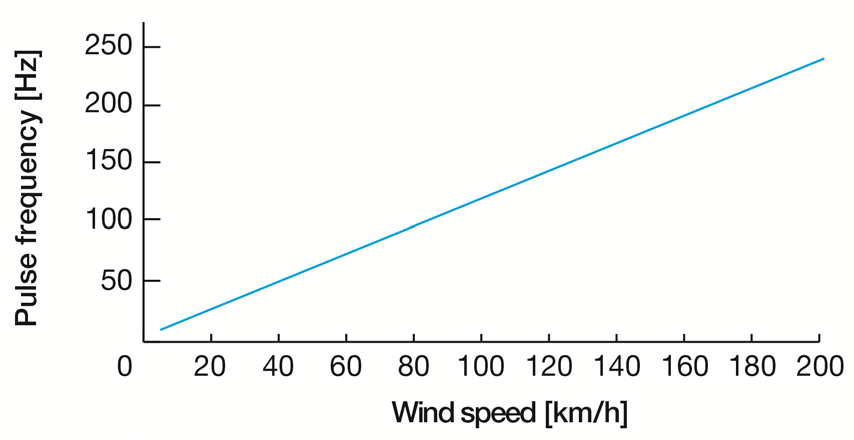
The sensor uses a reed switch: as the cups rotate, the reed contact opens and closes at a frequency proportional to the wind speed, so the receiving electronics only need to count pulses rather than measure an analogue signal. This keeps power consumption low. An internal 100nF capacitor across the reed contact acts as a signal filter, with a 1kΩ series resistor limiting current.
Wind speed is derived from the pulse frequency with:
Speed (km/h) = 0.8 × Hz + 3
Technical specifications
| Electrical | |
|---|---|
| Power supply | 3–24 Vdc |
| Maximum current | 24 mA |
| Output | Frequency (pulses) |
| Type of contact | Reed |
| Measurement | |
|---|---|
| Range | 3–180 km/h |
| Starting speed | 8 km/h |
| Survival speed | 200 km/h |
| Accuracy | 1 km/h (3–15 km/h); 3% (15–180 km/h) |
| General | |
|---|---|
| Material | PA + FG (reinforced polyamide) |
| Bearings | Stainless steel X65Cr13 |
| Weight | 130 g without cable; 1420 g with a 20 m cable |
| Dimensions | 125 × 139 mm |
| Storage temperature | −35 °C to +80 °C |
| Working temperature | −20 °C to +80 °C, without ice |
| Protection rating | IP65 (UNE 20324:1993) |
| EMC | EN 61000-6-2:2001, EN 55022:2001 Class B |
Wiring
The unit ships with a 3-core cable:
- Red — one side of the reed switch, through the internal 1kΩ resistor
- Yellow — the other side of the reed switch (pulse output)
- Black — the other leg of the internal 100nF filter capacitor
The sensor must be mounted vertically. For guidance on where to place it relative to your observatory, see CloudWatcher anemometer placement.
Full mechanical drawings, connector pinouts and additional accessories (mounting brackets, displays) are available directly from the manufacturer, IED Electronics Solutions S.L.