
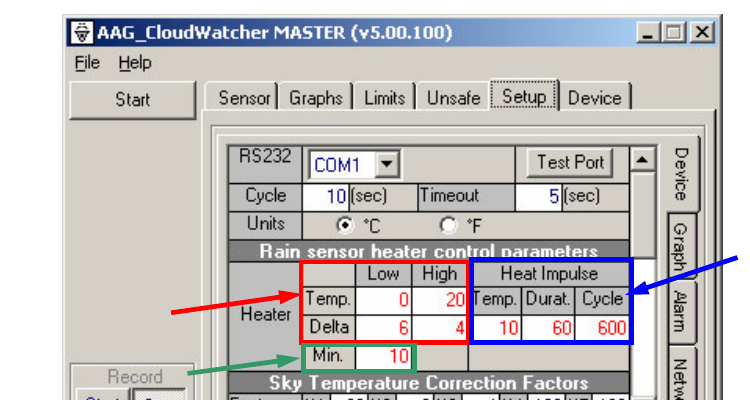
The red rectangle parameters
The red rectangle parameters define the target temperature for the rain sensor in terms of the ambient temperature.
- The field Temp of the Low column corresponds to the ambient temperature (ºC) below which the rain sensor operational temperature is kept at the value defined in the Delta field. For example, in the case illustrated above, for ambient temperatures below 0ºC the rain sensor operational temperature will be kept at 6ºC.
- The field Temp of the High column corresponds to the ambient temperature (ºC) above which the rain sensor operational temperature will be kept at the ambient temperature + the value defined in the Delta field. For example, for temperatures greater than 20ºC the rain sensor operational temperature will be adjusted to the ambient temperature + 4ºC.
- For ambient temperatures between the Low Temp and High Temp values, the system will calculate an increment which is directly proportional to the ambient temperature and limited by the Low Delta and High Delta values. This increment is added to the ambient temperature to establish the rain sensor target temperature.
The green rectangle parameter
The parameter Min corresponds to the minimum heating value. This value is a percentage and should be between 10 and 20 for stable behaviour.
This parameter may create a situation where the rain sensor temperature is above the value calculated by the red rectangle parameters. Under these circumstances the system will respect the minimum heating value even if the temperature is above the calculated target temperature.
The blue rectangle parameters (Heat Impulse)
The system will generate a heating impulse based on the parameters enclosed in the blue rectangle.
- The Heat Impulse mechanism has the objective of drying the rain sensor surface if it stays continuously WET/RAIN for the period of time defined by the Cycle field (in seconds).
- The duration of the pulse is given by the Durat field (in seconds), and the pulse intensity is calculated as the ambient temperature (ºC) + the Temp field (ºC). In the case illustrated above, the heat impulse will last 60 seconds at a temperature 10ºC higher than the ambient temperature, if the rain sensor stays WET/RAIN for a continuous period of at least 600 seconds (10 minutes).
Internal algorithm
For every read cycle, the target temperature for the rain sensor is calculated based on the actual ambient temperature and the red rectangle parameters described above.
- If the actual rain sensor temperature is above the calculated target temperature, then the rain sensor heater power is decreased. However, if the new rain heater power falls below the Minimum value (green rectangle parameter), the Minimum value is used instead.
- If the actual rain sensor temperature is below the calculated target temperature, then the rain sensor heater power is increased.
The power adjustments performed to the rain heater power depend on the read cycle period and the difference between the actual temperature and the target temperature. For the default read cycle of 10 seconds, the following table is used to determine the variation to the rain sensor heating power:
Temperature difference between actual and target Percentage variation to heating power > 8 ºC 40% > 4 ºC 20% > 3 ºC 10% > 2 ºC 6% > 1 ºC 4% > 0.5 ºC 2% > 0.3 ºC 1% - If the rain sensor value has been wet/rain for at least the Cycle value (blue rectangle), the system will activate the heat impulse mechanism.
When the heat impulse mechanism is initiated, the power to the rain sensor is increased to 100% and kept at 100% while the rain sensor has not reached the impulse temperature (the ambient temperature + the Temp parameter of the blue rectangle).
The moment the rain sensor reaches this impulse temperature, the system considers it the target temperature and manages the rain sensor using the same approach as steps 1 and 2 above, keeping the rain sensor at this target temperature for the period defined by the Durat parameter.
After the period defined by Durat, the system reverts to normal operation, calculating the target temperature based on the red rectangle parameters and the ambient temperature.