
The intuitive mistake
The intuitive reasoning goes: a longer focal length guidescope gives a larger image scale, which means guide star position changes are larger in pixels, which means finer tracking errors can be detected. This sounds correct, and for ideal conditions, it is. But in practice the opposite is often true.
Why short wins in practice
The question worth asking is what level of accuracy you actually need from your mount, and what is enough for the kind of images you are making. A good mount will guide with an RMS, over long periods, under one arcsecond—under 0.5 arcsecond for a very good mount. You cannot expect nice, round stars at 3 metres of focal length with a 9-micron-pixel camera by loading that same mount with a long, 1.5-metre guide tube; that limitation is inherent to the mount, and a longer guidescope will not fix it—quite the opposite.
Flexure
A longer, heavier guidescope introduces more flexure. As the mount slews, the guide scope shifts slightly relative to the imaging scope. This differential flexure appears as a guiding error: the guide camera thinks the star has moved, sends a correction, and the imaging scope's actual pointing drifts. The longer and heavier the guidescope, the worse this problem becomes. Differential flexure is not the only culprit, either—wandering mirrors and weak focusers can introduce the same kind of relative motion between the guiding optical system and the imaging one. If you cannot tame your optical setup, the only real fallback is an off-axis guider, though that is a hard way to go.
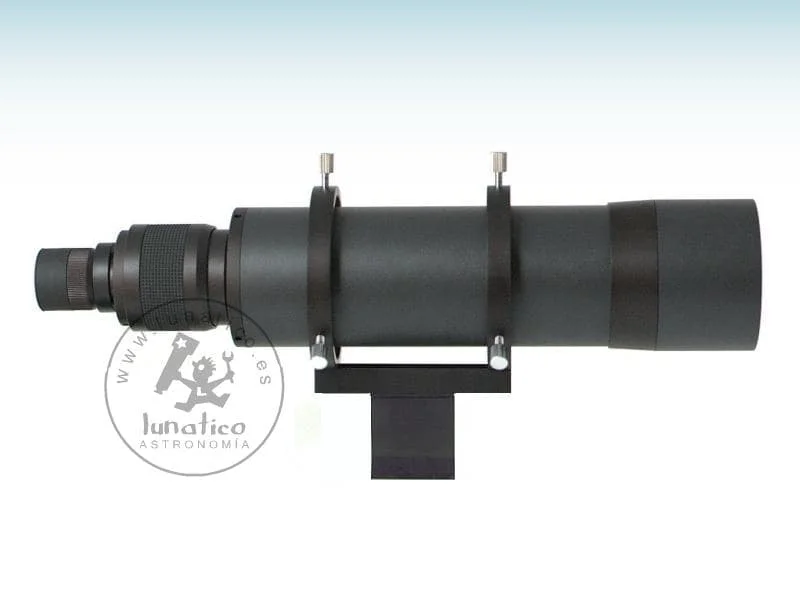
A short, lightweight guidescope—60mm aperture is typical—introduces far less flexure than a long one, simply by being smaller and lighter, and therefore less prone to flexure and vibration.
Atmospheric seeing
In conditions with poor seeing, a long focal length guidescope amplifies atmospheric scintillation of the guide star. The guide star image wanders more in pixels, the guiding software overcorrects, and the result is more movement in the imaging train, not less. A shorter focal length produces a smaller image scale—so the same seeing moves the guide star fewer pixels—and the guiding loop remains stable.
Guide star availability
A short guidescope has a wider field of view, which makes it much easier to find a suitable guide star anywhere in the sky. A long focal length guide scope may struggle to find a bright enough star within its narrow field without rotating it or repositioning the imaging setup.
The QHY5 guide camera
With current guiding software capable of high levels of accuracy in determining star centroids, and the 60mm-diameter, 230mm-focal-length guidescope we offer paired with a guide camera such as the QHY5—5.2-micron pixels, giving a resolution of 4.7 arc seconds per pixel—we can confidently guide with an RMS under 1 arcsecond, with a really improved image: stable, and not seeing-impaired.
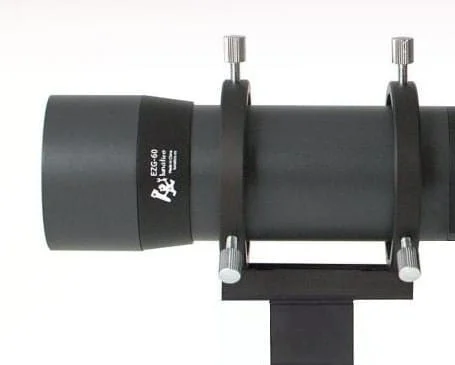
A longer guide scope is never the solution—it only amplifies flexure and seeing effects. The guidescope Lunatico offers is 60mm in diameter with a 230mm focal length.