In its normal habitat, the job of the anemometer is simple. It measures the wind speed at height to ensure that tolerances are not exceeded, thereby protecting people and equipment. In this case, the ambient wind at the highest point is important and the anemometer is generally free from local effects such as trees and buildings.
For the astronomer, the situation is a little more complex. We also use an anemometer to protect our equipment from strong winds. Normally, however, we want to ensure that our observing sessions are not compromised by wind induced movement of telescope.
Ideally, our anemometer would be mounted on the telescope itself, but this is not practical for most people and it is most likely that you will need to choose a location where you can easily mount the device, close to the observatory.
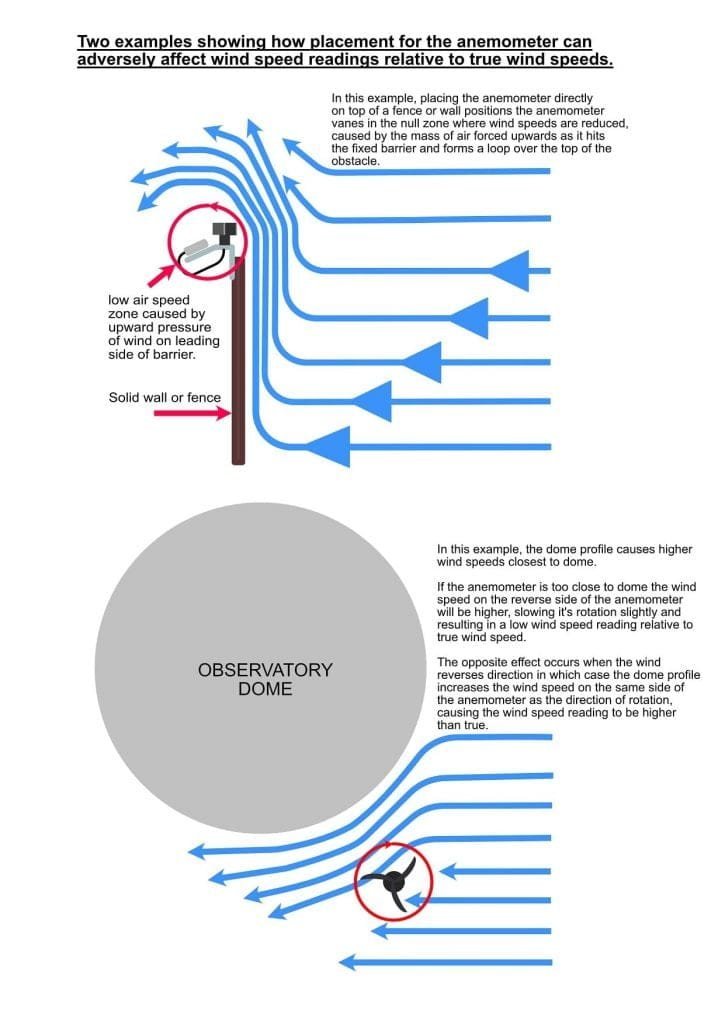
But what is the ideal location? This question is perhaps best answered the other way round. Here are three locations where we would not advise locating the anemometer. (With special thanks to William Bristow for the illustration!)
- On a house roof. It may be tempting to try to get the most accurate wind information by siting the device as high as possible. However, if your observatory is at a lower level, then the measured wind is unlikely to bear any relation to that experienced by your telescope and may cause you to abort sessions unnecessarily.
- On the side of a rolling roof observatory. You might think that the side wall of an observatory would be the ideal location to measure the wind close to the telescope, but as William’s diagram makes clear, dependent of the wind direction, there may be a significant distortion of the measured wind speed caused by air hitting the side of the observatory.
- On the side of a dome. Again, it may be tempting to mount the anemometer on the side of a classic domed observatory, but William’s illustration shows that, in this case, dependent of wind direction, there may be an over of under reading caused by air being channelled between the anemometer and observatory.
With these restrictions in mind, we can imagine that the optimum location for wind readings is likely to be close to the observatory, but far enough away that local effects don’t distort the measurements. A free-standing post, perhaps a meter away from the observatory might prove a good starting point.
As always, if you would like to share your thoughts and experiences with other users, please feel free to post to the forum. If you require help regarding your anemometer, or any other Lunático product, please get in touch with us at support@lunaticoastro.com,where we will be pleased to help you.
Andy